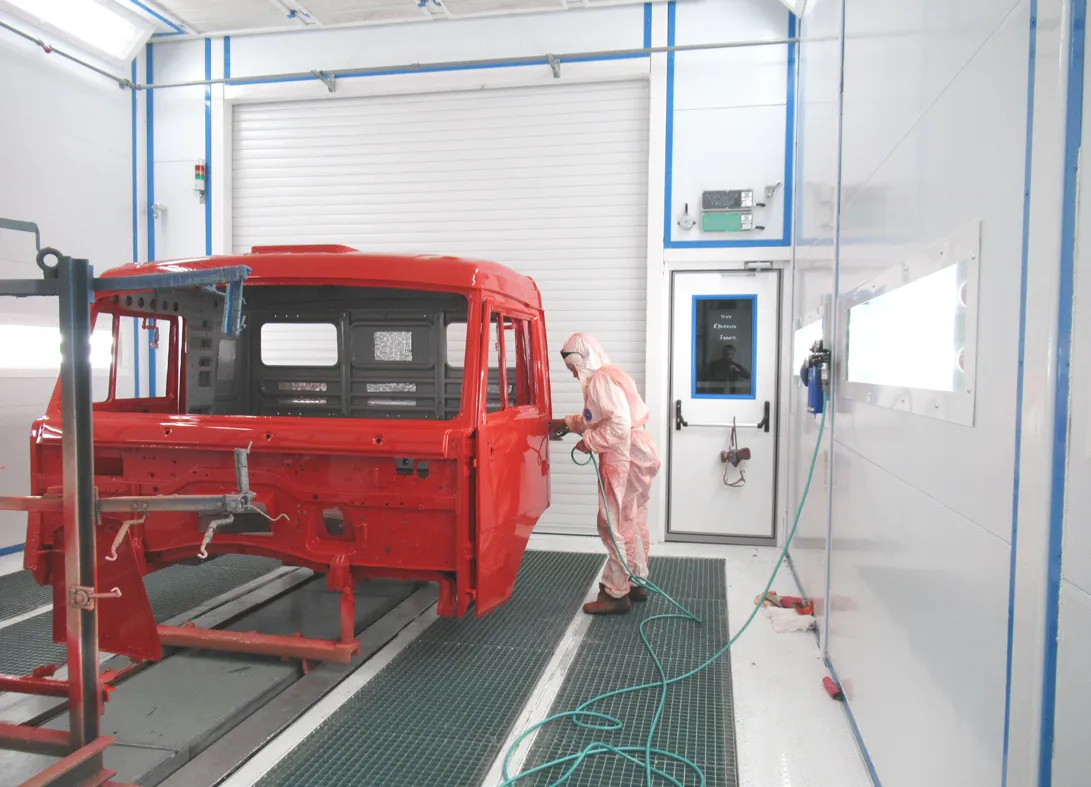
Proper paint booth ventilation is key to coating quality and personnel safety. We examine the main principles of air exchange design in EMT industrial paint booths.
The ventilation system design of paint booths is a core element for ensuring coating quality and operational safety. Proper airflow organization effectively controls paint mist diffusion, prevents coating defects, and protects operators from harmful gases. EMT has accumulated extensive engineering experience in paint booth ventilation design.
The core metrics of paint booth ventilation systems are air changes per hour and air velocity. For liquid coating spraying, EMT recommends maintaining cross-sectional air velocity of 0.3-0.5 m/s in the spraying area, ensuring paint mist is carried away promptly without disturbing spray operations. Powder spray booths require lower air velocity (0.2-0.3 m/s) to avoid excessive powder dispersion.
Airflow direction design directly affects coating quality. EMT employs a downdraft design with air entering from the ceiling and exhausting from the floor—the internationally recognized best practice. Clean air enters uniformly from the ceiling, passes through filters, and descends vertically in laminar flow, carrying paint mist toward floor exhaust vents. This design ensures operators are always in clean air while preventing paint mist from contaminating already-coated workpiece surfaces.
The supply air filtration system typically uses G4 pre-filter + F7 medium-efficiency two-stage filtration to ensure incoming air cleanliness meets coating requirements. The exhaust end is equipped with paint mist capture systems—dry filtration or water curtain for mist removal followed by activated carbon adsorption treatment to ensure compliant emissions. EMT provides customized ventilation system solutions based on specific process needs and environmental requirements.
The core metrics of paint booth ventilation systems are air changes per hour and air velocity. For liquid coating spraying, EMT recommends maintaining cross-sectional air velocity of 0.3-0.5 m/s in the spraying area, ensuring paint mist is carried away promptly without disturbing spray operations. Powder spray booths require lower air velocity (0.2-0.3 m/s) to avoid excessive powder dispersion.
Airflow direction design directly affects coating quality. EMT employs a downdraft design with air entering from the ceiling and exhausting from the floor—the internationally recognized best practice. Clean air enters uniformly from the ceiling, passes through filters, and descends vertically in laminar flow, carrying paint mist toward floor exhaust vents. This design ensures operators are always in clean air while preventing paint mist from contaminating already-coated workpiece surfaces.
The supply air filtration system typically uses G4 pre-filter + F7 medium-efficiency two-stage filtration to ensure incoming air cleanliness meets coating requirements. The exhaust end is equipped with paint mist capture systems—dry filtration or water curtain for mist removal followed by activated carbon adsorption treatment to ensure compliant emissions. EMT provides customized ventilation system solutions based on specific process needs and environmental requirements.