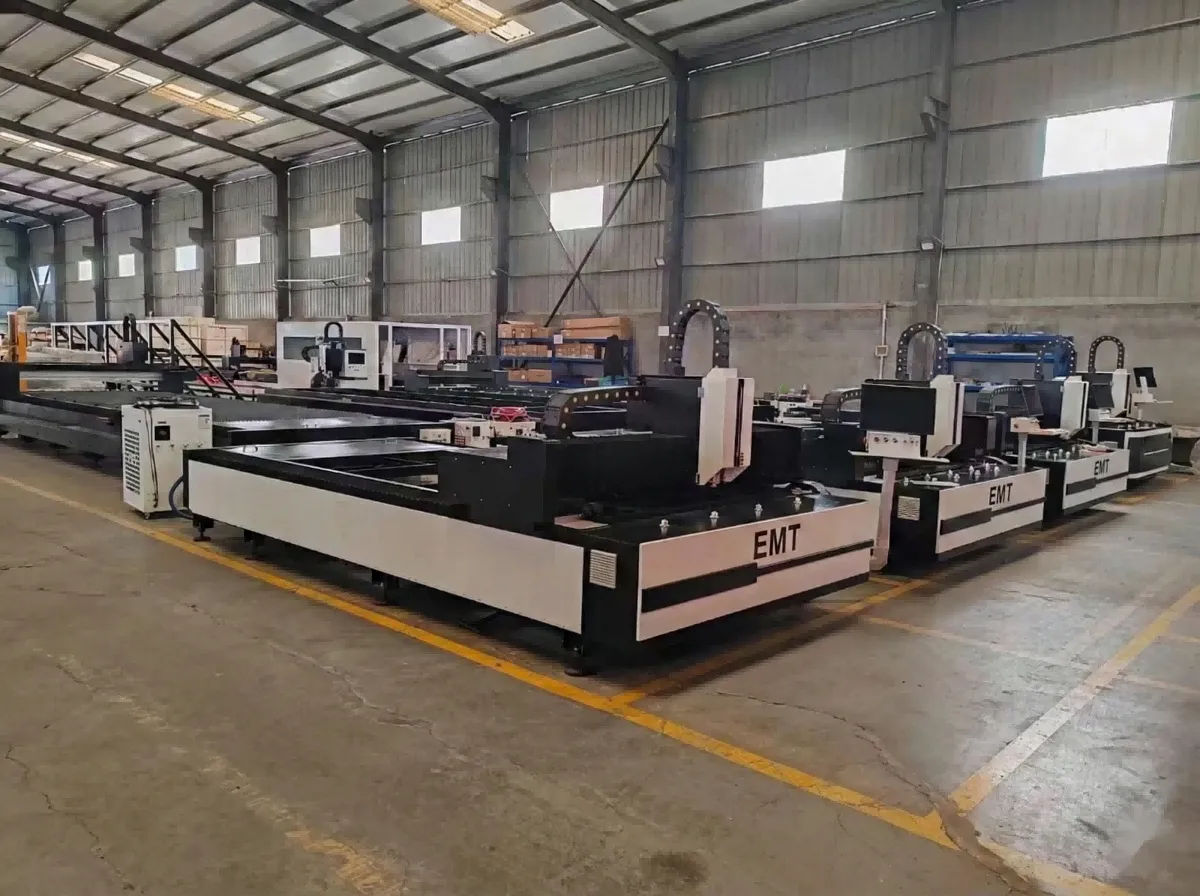
Comparison of fiber and CO2 lasers for metal cutting. EMT fiber lasers provide 3x faster cutting speed for thin sheets and significant energy savings.
Laser cutting technology has become an indispensable tool in the metalworking industry, and choosing between fiber lasers and CO2 lasers is a critical decision many enterprises face. EMT draws on years of industry experience to provide a comprehensive analysis of both technologies.
In terms of cutting speed, fiber lasers have an overwhelming advantage in thin sheet processing. When cutting carbon steel and stainless steel under 3mm, fiber laser speeds are over 3 times faster than CO2 lasers. However, when cutting thick plates (carbon steel over 20mm), the speed gap narrows significantly, and CO2 lasers still hold some advantage in cross-section quality for thick plate cutting.
Energy consumption comparison is one of fiber lasers' most outstanding advantages. Fiber lasers achieve photoelectric conversion efficiency of approximately 30-35%, while CO2 lasers only reach 10-15%. This means fiber lasers consume less than half the electricity of CO2 lasers at equivalent power. For a 6kW laser, fiber lasers can save approximately $20,000-30,000 annually in electricity costs.
Regarding maintenance costs, fiber lasers are virtually maintenance-free. There are no mirrors, lenses, or other optical components requiring regular replacement and adjustment, with laser source lifespans exceeding 100,000 hours. CO2 lasers require regular gas mixture replacement and mirror cleaning, resulting in higher annual maintenance costs.
EMT recommends: for enterprises primarily processing thin sheets, fiber lasers are the optimal choice. EMT offers a complete range of fiber laser cutting machines from 1kW to 30kW to meet all processing requirements.
In terms of cutting speed, fiber lasers have an overwhelming advantage in thin sheet processing. When cutting carbon steel and stainless steel under 3mm, fiber laser speeds are over 3 times faster than CO2 lasers. However, when cutting thick plates (carbon steel over 20mm), the speed gap narrows significantly, and CO2 lasers still hold some advantage in cross-section quality for thick plate cutting.
Energy consumption comparison is one of fiber lasers' most outstanding advantages. Fiber lasers achieve photoelectric conversion efficiency of approximately 30-35%, while CO2 lasers only reach 10-15%. This means fiber lasers consume less than half the electricity of CO2 lasers at equivalent power. For a 6kW laser, fiber lasers can save approximately $20,000-30,000 annually in electricity costs.
Regarding maintenance costs, fiber lasers are virtually maintenance-free. There are no mirrors, lenses, or other optical components requiring regular replacement and adjustment, with laser source lifespans exceeding 100,000 hours. CO2 lasers require regular gas mixture replacement and mirror cleaning, resulting in higher annual maintenance costs.
EMT recommends: for enterprises primarily processing thin sheets, fiber lasers are the optimal choice. EMT offers a complete range of fiber laser cutting machines from 1kW to 30kW to meet all processing requirements.